Tuesday, May 5. 2009
-- The value and vanity of fame
[Note: In this posting, the term "trademark" includes both trademark and service mark. Also, jurisdictionally I refer primarily to federal trademark protections, not state protections, except where explicitly stated otherwise.]
Trademark protections are generally limited by national boundaries. A trademark that is protected in, say, Germany does not automatically mean it will be protected in US. Particularly, trademark protections are conditioned on "use", but this "use" generally is limited geographically only to uses within US territories. Therefore, a trademark first used in a foreign country may not necessarily be protected in US, if it was not first used in US.
In an increasingly globalized economy, such territorial limit is bound to give rise to an increasing number of disputes. The recession and the consequential shift of focus to the domestic economy in many developing countries (particularly BRIC: Brazil, Russia, India, & China) will only accelerate the trend. -- Many small, strictly domestic businesses in these developing countries will benefit from the thriving domestic economy and grow quickly into national franchises. At that point, these businesses will seriously plan expansions into the US markets, but might find their trademarks already used by others in US. It's predictable that many of these foreign businesses will challenge the existing US trademarks, in an attempt to extend their foreign trademark protections to US.
In general, because of the territorial limit of trademark protections described above, these foreign businesses will not prevail. US courts, nonetheless, have recognized an exception to the territorial limit of trademark protections, and have granted protections to foreign trademarks (that were used in US later than other domestic trademarks) if they are "famous" or "well-known" in US. This "well-know mark" exception, however, is not derived from express US trademark laws, and as a consequence has created conflicts among different courts.
Consider first a case in California. A large supermarket chain in Mexico had used and registered the mark GIGANTE in Mexico (but not in US) since 1960s. A US company opened two food stores in California in 1990s and called them "Gigante Market". Then beginning in 1999, the Mexican supermarket chain entered the US market and opened several stores in Los Angeles and called them "Gigante". Lawsuits ensued to determine who, the US company or the Mexican supermarket, has right to the GIGANTE mark. The 9th Circuit Court recognized the "well-known mark" exception and held that the Mexican supermarket chain, which first used the GIGANTE mark in Mexico, could have rights to the mark in US, if the mark was determined to have been "well-known" in California, among other factors.
In 2007, however, the 2nd Circuit Court in NY reached an opposite conclusion from the 9th Circuit Court. In the NY case, the ITC Hotel established Bukhara Restaurant in 1977 in New Delhi, India. The restaurant was voted Best Asian restaurant and one of the top 50 in the world by Restaurant Magazine of UK in 2007. ITC did open a restaurant in Manhattan in 1987 but closed it in 1991. In 1999, several ex-employees of the original Bukhara Restaurant opened two restaurants in Manhattan. The new restaurants were named Bukhara Grill and had similar interior deco as the original ones. The New Delhi Bukhara sued the New York Bukhara, asserting the "well-known mark" protection. The 2nd Circuit Court, however, refused to recognize the "well-known mark" exception, citing absence of a clear intention of the Congress to enact such an exception into federal trademark laws.
As a result, currently foreign "well-known marks" can be protected by federal laws in the states within the 9th Circuit (AK, AZ, CA, HI, ID, MT, NV, OR, WA), but not in NY. The conflict will need to be resolved by the Supreme Court or by the Congress.
Finally, I note that the 2nd Circuit Court in the Bukhara case eventually asked the NY State's highest court to help answer whether a foreign "well know mark" may be protected under NY state laws. The NY's highest court answered, "Yes", although under the theory of misappropriation of commercial advantages in the unfair competition context, not as a "well-known mark" exception to the territorial limit on trademark protections.
The pursuit of fame
Turns out to be not in vain,
Insofar as a mark of trade
Is the center of the realm.
It's the federal or the state
That will be the game.
Wednesday, March 11. 2009
-- Risk & reward
[NOTE: This article was originally written in Chinese in January 2009, and published in the newspaper World Journal on 2/26/2009. I want to thank the World Journal for its generous permission for me to post this updated English version here.]
President Obama's $787 billion economic stimulus plan is now in full swing. The enormous government spending plan spans several key areas, including tax cuts, social welfare, education, healthcare, housing, scientific research, infrastructure, and energy. It was clear from the beginning, however, that climate change was one of the most important elements in his stimulus plan.
Aiming to turn the public's concerns over climate change (and the related issue of energy self-reliance) into the driving motor for economic growth, the president's plan will invest heavily in energy-related infrastructure construction, such as smart power grid and renewable energy. It will also invest in other venues capable of reducing greenhouse gas emission, including improving energy efficiency, electric vehicles, or green manufacturing facilities.
For those concerned with potential undesirable human impacts on the earth's climate, the stimulus package should be exciting news. Climate change, however, is still a controversial subject, entailing numerous uncertainties and risks. It will be necessary to understand these risks to properly understand the associated risks introduced into the stimulus plan, and the economy, by the inclusion of the "climate change" element.
- Government bureaucracy: Greenhouse gases are invisible and odorless, and pose no direct harm to human health. Releasing the gases into the air incurs little, if any, direct costs. As a result, large-scale reduction in greenhouse gas emission is unlikely, unless the government intervenes to regulate the activities. Government bureaucracy, nonetheless, introduces a first layer of risks into the stimulus plan.
- The gap from science to policy: A majority of scientists now agree that human activities and the greenhouse gases they generate were principally responsible for the drastic rise in the earth's surface temperature during the past century. Uncertainties, however, still exist due to several factors such as the natural fluctuations in the earth's climate, the uncertainties in our models of climate change, the uncertainties regarding the impact of human activities, and the errors in data collected. These uncertainties will result in a gap from science to policy, adding another layer of risks.
- Broad scope of influence: Every corner of our modern industrial society, including power plants, industrial factories, transportation, agricultural activities, or buildings, directly or indirectly releases greenhouse gases. The impact of any government policy will be broad in scope and enduring in time, which increases the risk of heightened political confrontation.
- Cost pressure: Businesses need to invest in research, equipments, or services to reduce greenhouse gas emission. With the weak economy, the cost pressure will transform into high political pressure, diminishing the efficacy of the stimulus plan.
- Immature technology: Green tech has made significant progresses in the past decades, leading to successful products such as solar photovoltaic panels, wind turbines, hybrid engines, etc. There is still a long way to go, however, before green tech can upstage petro fuel as our main energy source, and otherwise reduce greenhouse gas emission in other areas. In the 70's, US implemented a cap-and-trade system to reduce the emission of sulfur dioxide that was the source of acid rain. The system successfully stimulated development in new technology, and achieved its goals in less than 50 years. It is unknown, however, whether the domestic experience can be transplanted to the global climate change issue.
- Uncertain market demand: In the past several months, the oil price has fallen from ~$147 to less than $40 a barrel. [UPDATE: The oil has rebounded recently to ~$50 / barrel.] If global economy and oil prices remain depressed, so will the market for credits in greenhouse gas emission reduction (a/k/a carbon credits), delaying the development and implementation of new green tech.
- Reluctance by developing nations to participate: Among the 4 BRIC nations, China has become the world leader in the aggregate amount of greenhouse gas emission, surpassing US recently. The emissions by Brazil, Russia, and India are not too far behind or are increasing rapidly. These 4 nations, however, have been reluctant to limit the greenhouse gas emission of their domestic businesses, for fear of slowing their own domestic economic growth. As a consequence, political pressures have been mounting within US against unilateral reduction in domestic greenhouse gas emission. This political pressure will not disappear in spite of the new government.
- Unintended consequence: Several years ago, the US government encouraged the production of ethanol as a replacement of petro oil. Many farmers therefore sold the corns from their farms for the production of ethanol, which resulted in shortage of corns in the food markets and caused food prices to surge. All the other methods in reducing greenhouse gas emission may result in similar unintended consequences in the complex societal or biological chains.
In light of these risks, and the surging federal deficits, the rate of success of the stimulus package will depend on its ability to attract diverse private investments and international participation. To the private sectors, on the other hand, these risks may represent new demands and new markets. When viewed from the right angle, risk and rewards are often two sides of the same coin.
For a Chinese version published on the World Journal, please click the link at the end of this paragraph. 欲閱讀在世界日報上發表的中文版, 請按此連結鍵 here.
Friday, March 7. 2008
-- In the context of greenhouse gas emission and climate change
It is well known that air is a type of "public goods", which normally cost little to use. A public good generally carries the characteristic that everyone can use it without significantly affecting the use by others, and therefore free of costs. (For example, see here.) Water is another "public good" natural resource. In some occasions, lands and soils can be another type of "public good".
The "public good" nature of air is the fundamental root behind the climate change issues supposedly caused by human activities. Because it costs little to emit greenhouse gases into the air, there is little financial incentive to stop. Unless, that is, people voluntarily choose to stop, or are involuntarily required to stop by government regulations.
Government regulations, therefore, play an important role in managing the air quality, because they create financial incentives, and thus markets, for people to change behaviors. Availability of financial incentives and markets, on the other hand, is critical in stimulating capital investments and innovations. (Many people have studied this area. See, eg, here.)
This causal relationship between regulations, markets, and innovations is clearly illustrated by a paper I recently read. The paper was written in 2001 by Taylor, Rubin, & Hounshell of Carnegie Mellon U, and titled "The effect of government actions on technological innovation for SO2 control". The authors analyzed the correlations between the Clean Air Act and innovative activities in the reduction of SO2 emissions among power utilities. One of the approaches they used was to collect the numbers of patents issued each year in technologies related to the reduction of SO2 emissions from 1887 to 1997. They discovered that US patents related to SO2 control technology surged during a 5 year period encompassing the enactment of the 1970 Clean Air Act, rising from under 5 patents issued each year before 1967 to more than 75 patents issued in 1971. And the level of issued patents remained above the 1971 level for the rest of the study period that ended in 1997. (See Fig 4 of the paper here.)
The authors noted that prior to the Clean Air Act f 1970, when EPA was established, the patenting activities in SO2 control technologies were nearly non-existent, even though the federal governments had generously granted research funds in the areas. Today, the federal government has been debating whether to directly regulate greenhouse gas emissions (by taxes or caps) or to avoid direct regulations by providing research funding. At lease in terms of patenting activity, the Taylor paper should shed some light on the debate.
Tuesday, March 4. 2008
-- According to United Nations estimates
In my previous posting (see here), I estimated that the potential size of the greenhouse gas (GHG) markets could reach the level of US$500 billion to US$8 trillion by year 2030. That estimate was based on the amount of GHG emission reductions needed to stabilize the GHG concentration in the atmosphere (100 billion tons by 2030) and the potential market price of GHG (US$5 - US$80 per ton).
I just found out, however, that before my posting, the United Nation itself had came up with a direct estimate of the potential amount of investments necessary to avoid the undesirable consequences related to GHG emissions. (Report of the Secretary-General, "Overview of United Nations activities in relation to climate change", 10 January 2008. See here.) Its estimate was: US$15 trillion to US$20 trillion by 2030. Below is the relevant quote from the UN report.
"Global investments in the magnitude of from 15 trillion to 20 trillion United States dollars may be required over the next 20-25 years to place the world on a markedly different and sustainable energy trajectory."
The UN numbers are far greater than my estimates, although the UN report did not explain how it made the calculations. Assuming my approach is generally correct, on the other hand, the UN number would imply that the market price of GHG could reach US$200 each ton. ($20 trillion / 100 billion ton = $200 per ton) That is ~560% return in ~25 years from the current price of ~$30 per ton, or ~7.8% annually, absent leverage.
Friday, February 22. 2008
[Note: The abbreviation "GHG" represents "Greenhouse Gas".]
A couple of months ago, I went to a speech on environmental law. One of the speakers commented half-jokingly that just a few years ago environmental lawyers had pretty low popularity ratings. The presence of environmental lawyers in a transaction normally was considered a sign that troubles were brewing ahead. No more, the speaker said with a grin. These days, environmental lawyers are like rock stars, attracting admiring attentions.
Because of the rising public awareness of the risks associated with the alarming trends in global climate changes, investments in the GHG markets have surged recently, in tandem with the rising popularity of environmental lawyers. It was not too long ago, however, when "green investment" (which includes "GHG investment") was often met with skeptical eyes. The markets then were simply too small and the returns too low. Of course, concerns over global warming and the market-based framework set forth under Kyoto Treaty have changed the calculus. But the question remains whether this segment of the green markets can grow large enough to sustain sufficiently high returns. Other related questions also linger around for investors: Is this market already too crowded? Is it too late to enter? How long can investments continue to generate sufficient returns?
Answers to these questions likely depend on two key factors: The amount of GHG emissions we will have to (or want to, or be able to) reduce, and the market price of GHG. For example, if we manage to cut 100 billion tons of GHG emissions within the next 50 years, and if the price of a ton of GHG is worth $1 throughout the period (an arbitrary assumption), then we have a potential demand of $100 billion. Our economy would have to invest that much capital within the period to invent new technologies, systems, or policies, or to implement existing technologies, systems, or policies.
To get a more realistic estimate of the necessary amount of GHG emission cuts, I turned to the report published by the Intergovernmental Panel on Climate Change (IPCC). Recently, the panel published its "Climate Change 2007" final report. The report included estimates of the amount of GHG emissions that we would need to cut within the next century in order to stabilize the amount of atmospheric GHG at a sufficiently low level. According to the report, we need to cut in the order of ~100 billion tons of GHG between 2000 and 2030, and over 2 trillion tons of GHG between 2000 and 2100. (See table below.) Moreover, the panel estimated that the price of GHG could fall within the range of $5-$80 per ton. (Currently, carbon prices in Europe is ~$32. See here.) So, these numbers project the size of the GHG market in the order of ~$500 billion to ~ $8 trillion by 2030, and to grow 10- to 20-fold by the end of the century.
Computer Model Estimates of GHG Emission Cuts Needed to Stabilize Atmospheric GHG Concentrations
| Model |
CO2 stabilize at 650 ppm*
|
CO2 stabilize at 490-540 ppm*
|
|
2000-2030
|
2000-2100 |
2000-2030
|
2000-2100 |
| 1 |
90 |
2700 |
220 |
4300 |
| 2 |
60 |
1800 |
200 |
3000 |
| 3 |
60 |
1900 |
230 |
3800 |
Note: All GHG emission numbers are in billion tons. The numbers are my own estimates based on a bar chart in the IPCC report. They do not represent the actual numbers used in the report.
*ppm = parts per million
|
To put these numbers in perspective, the IPCC report also estimated that energy infrastructure investments could total over $20 trillion by 2030. That means, the GHG market can account for ~3%-40% of total energy infrastructure investments before 2030, and the percentage will likely increase many fold by 2100.
$500 billion to $8 trillion of demand during the next 30 years is sizable. And the demands will likely surge rapidly before the end of the century, if we manage to pull our acts together and the computer models are correct. These numbers actually already need to be increased today, because the IPCC projections assumed that the growth rate of GHG emission would begin to abate beginning year 2000. Numbers in the IPCC report, however, also indicated that between 2000 and 2004, the annual GHG emission growth rate did not decline at all. The growth rate actually nearly doubled that in the previous decade. As a result, the GHG emission reductions will have to accelerate relative to the IPCC projections in order to reach stabilization as scheduled. That will increase the size of the GHG market.
Of course, these estimated ranges of GHG market size depend on the accuracy of the extremely complicated computer models. They also assumed that we human beings could achieve the scale of GHG emission reductions projected by these models. At this point, however, the observed climate changes seem to have outpaced most previous computer models. Whether or not we human beings can manage to achieve the projected GHG emission reduction goals, on the other hand, is a big question mark.
Human efforts or hypes alone will not be enough to achieve the GHG emission reduction goals. We will need to figure out ways to effectively reduce the net GHG emissions, counting emissions through every node along the chain of interactions. That's a monstrously difficult undertaking. We have made significant efforts since Kyoto. For example, last year alone we saw member nations of the Kyoto Treaty reached an agreement to begin negotiating a new protocol to succeed Kyoto; Australia ratified the Kyoto Treaty; and, even US managed to enact a new energy bill. Despite these efforts, global GHG emissions have continued to accelerate in recent years. Whether we human beings can manage to stabilize climate changes remains the greatest uncertainty in estimating the potential size of the GHG markets.
On a final note, investment funds controlled by governments have grown rapidly in size recently. It has been projected that these funds (called "sovereign wealth funds") can exceed $10 trillion by 2015. (See here.) That's more than the money needed to reach the GHG emission reduction target for year 2030 set by IPCC. Hopefully, managers of these sovereign wealth funds will increase their investments in this sector. That will be a win-win situation for the Earth and humanity!
Please click the link below for the Chinese version. 請按以下連結鍵閱讀中文版.
Continue reading "Potential size of the greenhouse gas markets"
Tuesday, December 18. 2007
Last weekend at the UN Climate Change Conference in Bali, UN member countries agreed on a road map to hammer out the post-2012 replacement for the Kyoto treaty, after a dramatic last-minute reversal of position of the US delegation. Today, the House passed an energy bill that will increase the fuel efficiency standard for all vehicles by 40% to 35 miles per gallon by 2020. The bill also requires that ethanol use increase 6-fold by 2022. The bill was sent to the White House. (See here & here.)
During the coming century, our nation's climate policy and energy policy will become more and more entangled and intertwined, simply because fossil fuels, the principal sources of greenhouse gases, happen to be also our principal energy sources. Let's not forget, however, that they are not equivalent to each other.
| Factors influencing energy policy-making |
Sources of green house gases |
Climate warming Energy independence & security Scarcity of energy sources Economic growth / job security Surging worldwide demand Rising political influence of developing nations Consumer protection Price stability Energy & financial market stability Politics / vested interests
|
Fossil fuels Livestocks Agricultural activities Land use & wetland changes Landfill emission Refrigeration systems Fertilizers |
As shown in the table, an energy policy must address various issues other than global warming. Meanwhile, a climate policy needs to address factors not associated with fossil energy use. For example, livestock feeding and agricultural activities have been known to account for around 15% of greenhouse gas emissions. Also, the global nature of climate change requires much greater international interactions than energy.
At this point, almost all factors influencing our energy policy are moving it closer and closer to our climate policy. Energy independence urges development of non-fossil energy sources (although coals, which are abundant domestically, satisfy this requirement). Declining worldwide oil reserves require development of new energy sources (although abundant coals can satisfy this end too). Even China is gradually waking to the reality that it cannot sustain strong economic growth if sea level rises dramatically and flooding or droughts become more severe.
These factors, nevertheless, may someday move away from their current direction, pulling our energy policy from our climate policy. (For example, if Mid-East stabilizes, or enormous new fossil energy reserves are discovered.) If that happens, oil & other fossil energy prices may remain low, disrupting markets for clean technologies and carbon credits. In that case, climate policies may encounter greater conflicts with energy policies.
We'll need to be aware of this possibility. And, at the same time, should work to find ways to reduce the amount of green house gases our farms' manures send to the sky!
Please click the link below for the Chinese version.
Continue reading "Climate policy & energy policy"
Monday, July 23. 2007
A trademark (or service mark) is not just the name of a product. It is the nickname of the source company when used with that particular product. A trademark tells customers the quality of the product (from the quality of the source company) they can expect by simply seeing (or hearing, smelling) the mark. it is a powerful 24/7 salesperson.
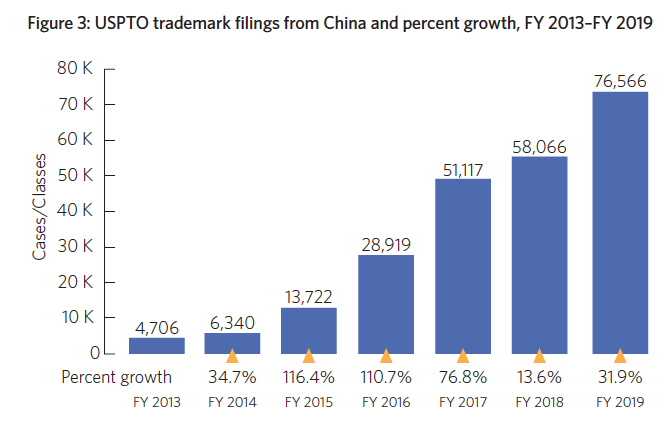
 Therefore, most companies don't want to use the marks already used by their competitors, and don't want their competitors to use the same (or similar) marks for competing products. (For example, earlier this year Cisco sued Apple to stop it from using its iPhone trademark. See here.) Registering a trademark is becoming a popular way to achieve these goals. The number of federal trademark applications has indeed steadily increased in the past several years. (See chart by clicking on thumbnail.)
The best way to protect a trademark, however, is not trademark registration, but to choose a good/distinctive mark to begin with. A good mark stands out from the crowd. It reduces the chances that the mark will be confused with other existing marks. It also reduces the chances that other companies in the future might innocently use similar marks for their own competing products.
A good mark can also allow a company to begin marketing a new product even before its trademark is registered. It takes on average more than one year to register a federal trademark. (See table.) Very often, companies cannot afford to wait that long to market a new product, if only to make sure that the product's trademark can be protected. Choosing a good trademark from the get-go will allow the company to market the product timely, without taking big risks.
Avg # Months Btwn Trademark Application & Registration
| 2002 |
2003 |
2004 |
2005 |
2006 |
| 18.3 |
16.2 |
16.2 |
17.2 |
15.5 |
Trademarks are generally categorized into 5 classes, with descending quality: Fanciful, Arbitrary, Suggestive, Descriptive, & Generic. (See here for more info.) Choose a fanciful or arbitrary mark to avoid stepping on other existing trademarks and to prevent others from innocently stepping on yours. Then, get register the trademark to officially announce your mark and to fend off others intentionally attempting to palm off your good name. That would be my best strategy.
Wednesday, March 28. 2007
The influential private equity firm, Blackstone Group, disclosed in its recent IPO prospectus that it planned to establish a charitable foundation after it goes public and would contribute up to $150m in the foundation. (See here.) This got me thinking about the combination of for-profit and not-for-profit corporations.
Most for-profit corporations, like Blackstone, do get involved in not-for-profit activities, directly or directly. However, most of these activities are normally initiated and controlled exclusively by the management, without much input from the shareholders. Such modus operandi simply adds to the public's cynicism toward corporate America's involvement in nonprofit -- particularly because there is a different way for corporations to contribute to the nonprofit causes. Let me explain.
The principle difference between a for-profit and not-for-profit corporation is ownership. A for-profit corporation has ownership, but a not-for-profit does not. However, what if the ownership of a for-profit corporation includes an interest in contribution by the corporation to some non-profit organizations? If that is possible, it will permit the shareholders to exercise direct control over the company's contribution to nonprofits. And I think it is possible.
For example, Blackstone in its IPO can set up multiple classes of shares, say Classes A, B, & C. When Blackstone initially issues the shares, a portion of the purchase price will go to the company (and invested for profit), but the remaining portion will go to some nonprofit groups. (See table below.) So, if I pay $100 for one Class B share, $90 goes to Blackstone, and $10 goes to some nonprofit groups. If I later sell the share in the secondary market, however, only the for-profit portion changes hands. Different classes will have different rates of dividends and/or different voting rights as incentives to purchase Classes C or B over Class A. Additionally, more complicated plans can offer different choices and combinations of nonprofit organizations for different classes.
|
Portion of for-profit purchase |
Portion of nonprofit purchase |
Dividend |
Voting rights |
| Class A |
100% |
0% |
D |
V |
| Class B |
90% |
10% |
1.05 * D |
1.05 * V |
| Class C |
80% |
20% |
1.10 * D |
1.10 * V |
Will such kind of plans work? It seems so. Will it actually happen? Maybe, although probably not any time soon!
Tuesday, February 20. 2007
In recent years, a secondary market for life insurance policies has grown rapidly, accompanied by similarly exponential growth in the securitization of life insurance policies. The market is supported by a group of organizers who purchase eligible policies from the original owners, re-package them, and then sell interests in these policies to investors. (See here or NY Times 12/17/2006 article "Late in Life, Finding a Bonanza in Life Insurance" for more details.)
Based on the numbers I was able to gather, the size of the market has grown from ~$1B in 1999 to over $10B in 2005. (See chart below.) This rapid growth was fueled mostly by institutional investors, such as hedge funds and Wall Street firms. Even Warren Buffet's Berkshire Hathaway has invested in life settlements. It has been estimated that the market can exceed $150B in terms of the face value of insurance policies involved.

There are occasions when a senior (or a company) might want to dispose of his/her life insurance policy. For example, emergency need for cash, changed goals in health care & estate planning, overly expensive premiums, dissolution of company requiring disposal of company-owned insurances, key employee leaving company, etc. In these occasions, the policy owner can sell the insurance back to the insurance company for the cash value. Or, he/she can sell the policy in the secondary market if it offers a better deal. Such competition between the primary and secondary markets should benefit consumers as a whole.
To continue its current pace of growth, however, the market must address several legal concerns. First, most state regulations require that the beneficiary of a life insurance police possess an "insurable interest" in the life and health of the insured. If a stranger without an "insurable interest" becomes the beneficiary of a life insurance covering the life of another person, the stranger has the monetary incentive to accelerate the death of the insured person. That is not a desirable public policy! Many states (including New York), however, have allowed a stranger to become the beneficiary if the insured person voluntarily agrees to the arrangement. Even with this exception, the risk of abuse can be real. It is important for all transactions to incorporate some safe guards. (E.g., not permitting the investors to know the identity of the insured.)
Second, the investment interests on the re-packaged insurances sold to investors may be "securities" under the federal Securities Act of 1933 and Securities Exchange Act of 1934, and thus may be subject to the registration, disclosure, anti-fraud, and other requirements under these federal laws. In 1996, the Appeals Court of the District of Columbia held in SEC v. Life Partners that such type of investment contracts are not "securities". The Appeals Court of the 11th Circuit, however, reached the opposite conclusion in 2006 in SEC v. Mutual Benefits. In these cases, the defendants, Life Partner Inc. and Mutual Benefits Corp., were organizers in the life settlement markets. Both of them employed hundreds of agents and brokers to purchase policies from seniors and sold fractional interests on these pools of policies to investors. Because of this split between the two courts, any issuance of life settlement interests under the jurisdiction of the 11th Circuit (Alabama, Georgia, Florida) will now be subject to the federal securities laws, but not those under the jurisdiction of D.C. Such discrepancy will have to be resolved by the Supreme Court.
Finally, as more and more organizers enter the market, competition to obtain eligible policies from seniors will increase. Potentials for fraud will rise. In fact, in October last year, the then attorney general of New York, Eliot Spitzer, brought suit against Coventry First, one of the large life settlement organizers, for allegedly rigging the bid process in buying the policies. Like many other states, New York currently does not have a law regulating the life settlement market. A model regulation, however, was released back in 2001 by the National Association of Insurance Commissioners. The model regulation was adopted by some states and contributed (at least partially) to the rapid growth of the industry. As this market grows, more and more states will eventually enact laws and regulations governing the industry. That should bring more clarity to the regulatory frameworks and sustain continued growth.
Thursday, February 15. 2007
COLI (Corporate-owned life insurance) has been around for a while. A company purchases life insurance policies (as owner and beneficiary) covering the lives of its employees for two main purposes: (1) to fund employee benefit plans; and (2) to compensate itself for the loss of covered key employees. In the former case, if the company sets up a retiree health care benefit plan for its employees, it can buy life insurances on its employees with face amounts equal to the estimated health care costs of the employees. The life insurance proceeds can subsequently be used to cover those health care costs. In the latter case, the insurance policy is called a "key-man" policy. A company buys key-man insurance policies sufficient to compensate for the losses and expenses to the company, or to buy back an employee-shareholder's shares, if a current key employee-shareholder passes away.
The federal tax treatments of a key-man COLI can be complicated. However, some of the main tax characteristics of a key-man COLI are:
- The premiums of the policy are NOT tax deductible for the company;
- The proceeds of the policy are tax free for the company;
- The proceeds of the policy MAY be subject to estate tax for the insured employee.
Characteristic #1 spawned various tax shelters in the 80's and 90's, which led to a series of federal COLI legislations, the most recent one being the COLI Best Practice Act incorporated in the Pension Protection Act, enacted on 8/17/2006. (See here for more details.)
Characteristic #3, on the other hand, may pose as a problem for a company where an employee-shareholder holds a controlling interest. Internal Revenue Code §2042(2) provides that proceeds of an insurance policy owned by and benefiting entities other than the insured person will be included in the insured's estate if the insured had any "incidents of ownership" on the policy. "Incidents of ownership" includes the power to change beneficiary, to surrender or cancel policy, to obtain a loan against the policy, etc. For a controlling employee-shareholder, this means that his estate MAY have to pay tax on the proceeds of the COLI covering his life, because he does have the above powers over the company. Fortunately, subsequent IRS regulations made it clear that as long as the COLI proceeds are paid only to the company or to a third party for a valid business purpose, the controlling employee-shareholder will not be considered to have "incidents of ownership" on the COLI. (26 C.F.R. §20.2042-1(c)(6))
Part of the reasons behind this regulation is that the company's stock price should reflect the insurance proceeds to be received by the company. That means the insured person's estate is taxed once already on the higher value of the stocks. Paying estate tax on the insurance proceeds would have been double taxation.
To be safe, however, a company having a controlling shareholder may want to prohibit (in its shareholder agreement) the company from changing the beneficiary of the COLI to any other entity without a valid business purpose. Or, to take it one step further, to limit the power of the controlling shareholder in managing the COLI.
A consideration in drafting a shareholder agreement or a buy-sell agreement.
|